Darlington and Sziklai pair
Darlington BJT pair and Sziklai transistor pair are specialized transistor configurations that combine multiple BJTs in a single package to enhance certain performance characteristics. They are typically used in high-frequency and high-power applications where standard BJTs perform poorly.
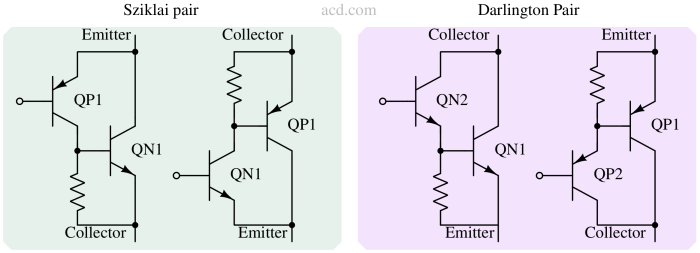
Problem with BJT's base current
The base current of a BJT increases a lot when the BJT is used to drive high-current loads. This is because the current density increases to a very high value with high current loads. With very high current density, the β falls sharply.
Also, while driving high current loads, the junction's temperature rises, which triggers temperature-dependent β degradation. These high current density and temperature conditions make driving high currents through a BJT output stage difficult. The base current requirement rises drastically which may take away all the bias current from the previous transistor stage and make the circuit unstable.
So, we need some helper transistor that supplies the base current and isolates the circuit preceding the output stage.
What is Darlington Transistor pair?
The Darlington pair is formed by connecting two BJTs together, where the emitter of the first BJT is connected to the base of the second BJT. This configuration provides a high current gain and is commonly used to amplify weak signals. The overall current gain of the Darlington pair is the product of the individual current gains of the two transistors, resulting in a significant overall gain.
Input impedance of Darlington pair
The input impedance of a Darlington pair is relatively high compared to a single BJT amplifier. To understand the input impedance of a Darlington pair, let's consider the simplified small-signal equivalent circuit:
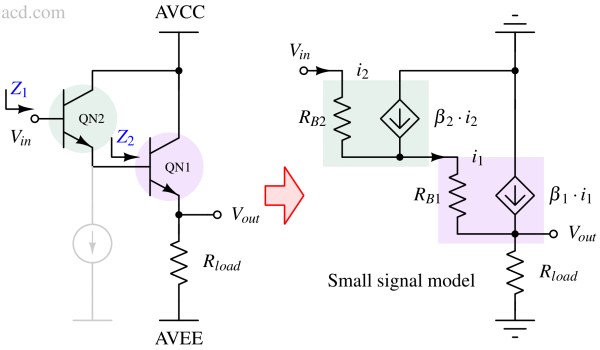
In this circuit, Vin is the input voltage, Vout is the output voltage, RB1 and RB2 are the small signal base resistors of QN1 and QN2 transistors, respectively, and RLoad is the load resistance.
The input impedance of the Darlington pair can be approximated as :
$$Z_1=R_{B2}+\beta{}_2Z_2$$
Where,
$$Z_2=(R_{B1}+\beta{}_1R_{load})$$
The overall input impedance of a Darlington pair is significantly higher than that of a single BJT because QN2 sees a higher resistance loading than QN1.
It's important to note that the actual input impedance of a Darlington pair can be affected by various factors, including the transistor parameters, biasing scheme, and any additional components in the circuit. Therefore, when designing or analyzing a specific Darlington pair circuit, it's necessary to consider these factors for accurate calculations.
Output impedance of Darlington pair
The Darlington pair's output impedance (Zout) is similar to a single transistor output impedance. The Zout of Darlington pair is :
$$Z_{out}=\cfrac{R_{B1}+R_{B2}\beta{}_2}{\beta{}_1}$$
For a single transistor output stage (Common collector), the output impedance Zout is:
$$Z_{out}=\cfrac{R_{B1}}{\beta{}_1}$$
So, the output impedance of the Darlington pair is a bit worse than a single transistor output impedance, but as long as β is high enough, it is not a concern.
Headroom requirement of Darlington pair
For proper functioning of the Darlington pair, both transistors QN1 and QN2 must turn-on. This requires 2VBE of input DC voltage. In comparison to the single transistor stage, it is one VBE high.
Sziklai darlington pair
The Sziklai pair, or the complementary Darlington pair, is a variation of the Darlington pair that utilizes one NPN and one PNP transistor. It provides similar performance characteristics as the Darlington pair but with the advantage of improved linearity and lower voltage drop. The Sziklai pair is commonly used in audio amplifiers and power output stages.
Advantages of Darlington and Sziklai pair
The Darlington and Sziklai pair has the advantage of high current gain, making them suitable for applications requiring high current amplification or switching. However, they also have some limitations, such as slower response times and higher input capacitance than a single BJT.
Applications
Compound BJTs can be found in discrete packages or integrated circuits (ICs). They are widely used in various applications, including audio amplifiers, power amplifiers, motor control circuits, and high-frequency RF amplification.
In IC 741 opamp, both the Darlington pair (CE-CE) and CC-CB stages are used.
References
- Contribution of Darlington : https://people.eecs.berkeley.edu/~hodges/DarlingtonCircuit.pdf