Audio transformer
As the name suggests, audio transformers are used in electronic audio circuits for signal coupling/isolation and impedance matching of amplifiers and speakers.
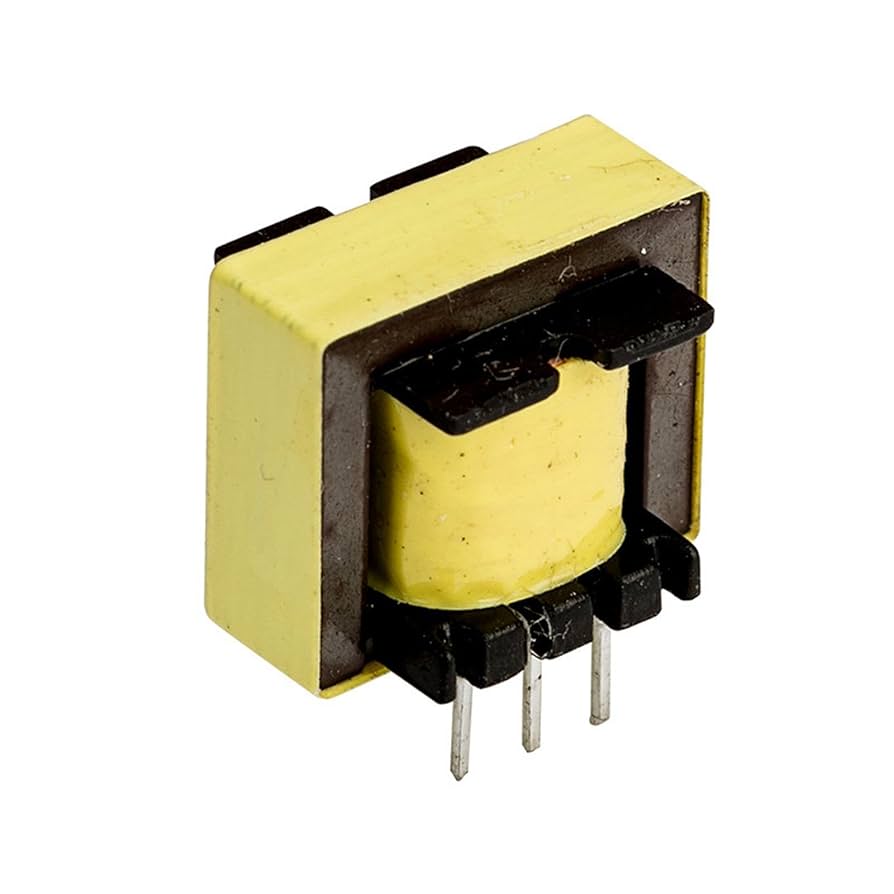
Like any other transformer, the audio transformer is also a passive device. This means that the power in the primary windings is the same as in the secondary windings. The bandwidth of an audio-transformer covers audio range of 20 Hz to 20 kHz. It specifies the lower and upper -3dB points. It emulates a bandpass filter. For speech only purposes, bandwidth of 300Hz to 3kHz is preferred allowing smaller size transformers.
Primary function of audio transformer
The primary functions of an audio transformer are :
- Isolation.
- Step up/down voltage.
- Impedance matching.
Impedance matching
If Zp is the primary winding impedance, (Zs) is the secondary winding impedance, ((Np/Ns)) is the transformer turns ratio, and (Vp/Vs) is the transformers voltage ratio, then we have following relation among them :
$$\cfrac{Z_p}{Z_s} = \left(\cfrac{N_p}{N_s}\right)^2 = \left(\cfrac{V_p}{V_s}\right)^2$$
Example :
An audio transformer with a turn ratio of 3.16:1 is to be used to match the output of a power amplifier to a loudspeaker. Suppose the amplifier's output impedance is 50Ω. Next, calculate the speaker's nominal impedance required for maximum power transfer.
$$\cfrac{Z_p}{Z_s} = \left(\cfrac{N_p}{N_s}\right)^2 = \cfrac{3.16^2}{1}\simeq{}10$$
$$\implies{} Z_s = \cfrac{Z_p}{10} = 5$$
With the help of the transformer, this power amplifier can drive 5Ω of speaker load.
Importance of impedance matching
Impedance matching avoids ringing (damping oscillations). The load resistance dampens the ringing (reduces the quality factor) of the LC resonance formed by transformer's L and parasitic capacitance. Having an open load at the secondary side while a very low resistance driving the primary side can cause ringing. The parasitic capacitance is due to the windings of the enameled copper wire's close spacing.
Distortion
Due to high load currents, the core of the transformer might get saturated. The relative permeability drops and inductance lowers. This phenomena is similar to switching converter's inductor saturation. This saturation causes distortion. So, choosing a transformer core with adequate saturation rating solves the distortion problem.
Multitap Audio transformers

Multitap audio transformers have multiple primary or secondary windings/connections (called "taps"). These offer different electrical impedances/step-up/down ratios in a single construction which save space.
Size and weight of Audio transformers
The size of an audio transformer depends on the following parameters :
- Frequency range.
- Current drive/power.
With lower frequency, to maintain the same impedance, the self/mutual inductance of the transformer has to be increased. Since self-inductance is directly proportional to size, size has to be increased to support low frequency.
The power that can delivered to a load depends on the thickness of the copper windings and the material of the core. To support high currents, it is necessary to increase the thickness of the copper windings.
100V audio line for PA systems
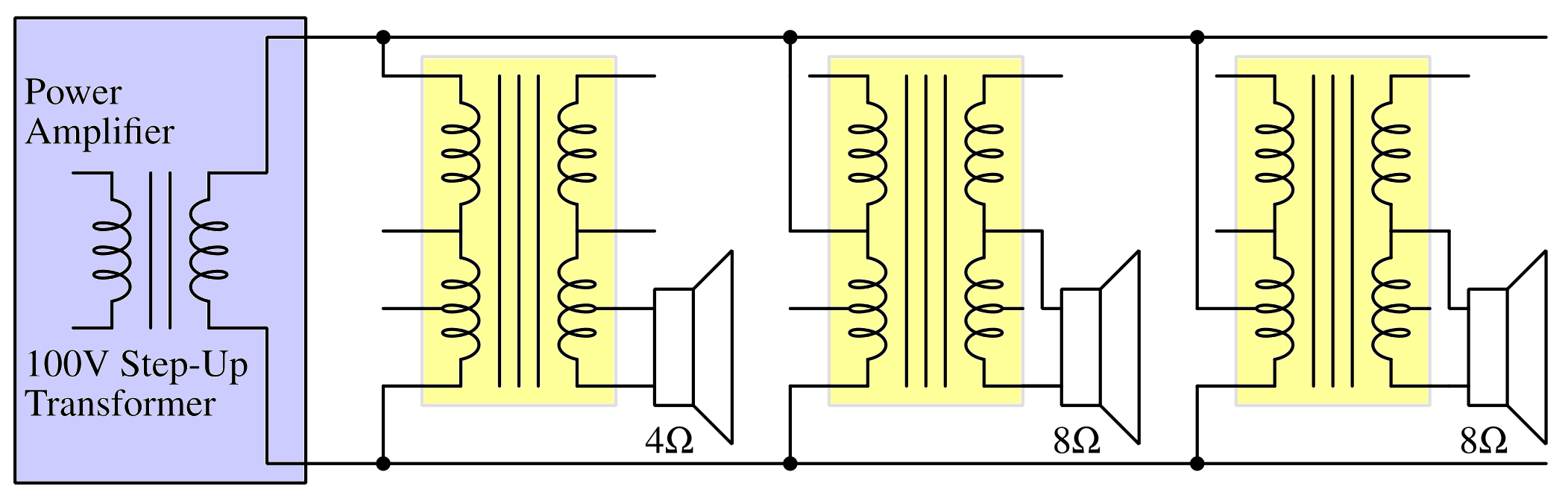
100V line audio is a standard solution that offers a simple interface for multiple speakers distributed over long distances, e.g.:
- Restaurants, Pubs, and Bars.
- Places of worship, schools, and colleges.
- Warehouses, factories, Offices.
- Supermarkets, shopping centers.
- Stadiums, Horse yards, etc.
The total wattage of all the loudspeakers added together must NOT be higher than the rated wattage of your amplifier. Each speaker has a built-in transformer that steps down the 100V to a lower voltage (e.g., 8 ohms) for the speaker driver. The transformer also allows you to select different power levels (e.g., 5W, 10W, 20W) for each speaker, allowing for customized volume levels in different areas. Speakers are wired in parallel, meaning they all receive the same voltage but can draw different amounts of power based on their tap settings.